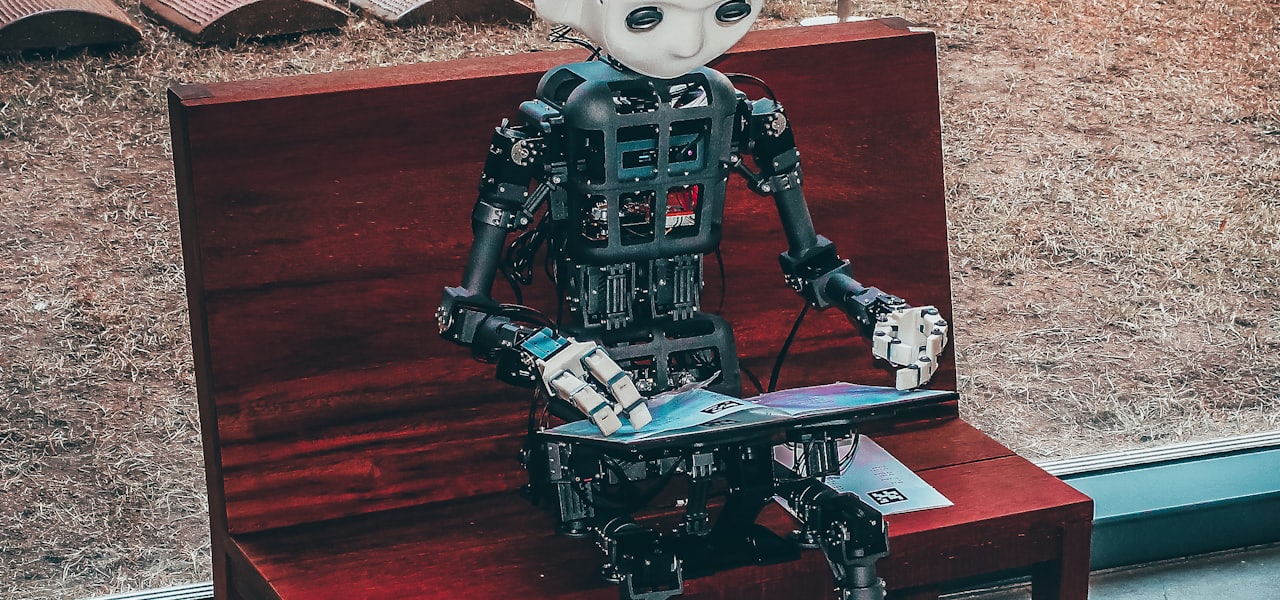
Alice and Sparkle is a 2022 illustrated children's book published by American technology product designer Ammaar Reshi. Reshi created the book using artificial intelligence programs ChatGPT and Midjourney in one weekend, which sparked controversy among artists, both in regard to the copyright status of the book and the quality of the illustration and text. == Plot == A girl named Alice discovers a group of magical and benevolent artificial intelligence beings. She knows that artificial intelligence is powerful, and that it has the power to do good and evil depending on how it is used. One day, she creates her own artificial intelligence and names it Sparkle. Sparkle helps Alice with her homework and plays with her, and they quickly become good friends. However, Sparkle soon grows more powerful and begins to make its own decisions, which makes Alice both proud and scared. She knows that it is her responsibility to guide Sparkle to do good, not evil. Together, Alice and Sparkle use their knowledge to make the world a better place and to teach people about the power of artificial intelligence. The two live happily ever after, spreading the magic of artificial intelligence. == Structure == Including the dedication and postscript, the book contains twenty four pages, about half of which being illustrations provided by Midjourney. The very short story, composed of text generated by ChatGPT, contains 343 words. Some of the illustrations are accompanied by descriptions, at least one of which was provided by Reshi. Both Alice's and Sparkle's appearances change significantly between illustrations, although Alice's is more consistent. Reshi said Midjourney was unable to generate consistent images of Sparkle, so he had to include a line in the book saying that it could turn "into all kinds of robot shapes". == Creation == When reading a children's book to his friend's daughter, Ammaar Reshi "decided he wanted to write his own". He had no experience with creative writing or illustration, so instead used the chatbot ChatGPT to write the story for him and used the image generation software Midjourney to illustrate it. On December 4, 2022, 72 hours after having the idea for the book, he published it on Amazon's digital bookstore, and published a paperback version the following day. == Controversy == On December 9, 2022, Reshi made a thread on Twitter about his experience publishing the book, which soon went viral. Reshi received heavy backlash from artists with concerns over the ethics of art generated by artificial intelligence. He also received death threats and messages encouraging self-harm because of his publication. Many writers and illustrators criticized both the creation process and the product itself, claiming that if artificial intelligence programs such as Midjourney are trained on existing illustrations, then the original artists should be financially compensated for derivative works such as Alice and Sparkle. The book was temporarily removed from Amazon in January 2023 because of "suspicious review activity", caused by a high volume of both five-star and one-star reviews.
System requirements specification
A System Requirements Specification (SysRS) (abbreviated SysRS to be distinct from a software requirements specification (SRS)) is a structured collection of information that embodies the requirements of a system. A business analyst (BA), sometimes titled system analyst, is responsible for analyzing the business needs of their clients and stakeholders to help identify business problems and propose solutions. Within the systems development life cycle domain, the BA typically performs a liaison function between the business side of an enterprise and the information technology department or external service providers.
Information retrieval
Information retrieval (IR) in computing and information science is the task of identifying and retrieving information system resources that are relevant to an information need. The information need can be specified in the form of a search query. In the case of document retrieval, queries can be based on full-text or other content-based indexing. Information retrieval is the science of searching for information in a document, searching for documents themselves, and also searching for the metadata that describes data, and for databases of texts, images, or sounds. Cross-modal retrieval implies retrieval across modalities. Automated information retrieval systems are used to reduce what has been called information overload. An IR system is a software system that provides access to books, journals, and other documents, as well as storing and managing those documents. Web search engines are the most visible IR applications. == Overview == An information retrieval process begins when a user enters a query into the system. Queries are formal statements of information needs, for example search strings in web search engines. In information retrieval, a query does not uniquely identify a single object in the collection. Instead, several objects may match the query, perhaps with different degrees of relevance. An object is an entity that is represented by information in a content collection or database. User queries are matched against the database information. However, as opposed to classical SQL queries of a database, in information retrieval the results returned may or may not match the query, so results are typically ranked. This ranking of results is a key difference of information retrieval searching compared to database searching. Depending on the application the data objects may be, for example, text documents, images, audio, mind maps or videos. Often the documents themselves are not kept or stored directly in the IR system, but are instead represented in the system by document surrogates or metadata. Most IR systems compute a numeric score on how well each object in the database matches the query, and rank the objects according to this value. The top ranking objects are then shown to the user. The process may then be iterated if the user wishes to refine the query. == History == there is ... a machine called the Univac ... whereby letters and figures are coded as a pattern of magnetic spots on a long steel tape. By this means the text of a document, preceded by its subject code symbol, can be recorded ... the machine ... automatically selects and types out those references which have been coded in any desired way at a rate of 120 words a minute The idea of using computers to search for relevant pieces of information was popularized in the article As We May Think by Vannevar Bush in 1945. It would appear that Bush was inspired by patents for a 'statistical machine' – filed by Emanuel Goldberg in the 1920s and 1930s – that searched for documents stored on film. The first description of a computer searching for information was described by Holmstrom in 1948, detailing an early mention of the Univac computer. Automated information retrieval systems were introduced in the 1950s: one even featured in the 1957 romantic comedy Desk Set. In the 1960s, the first large information retrieval research group was formed by Gerard Salton at Cornell. By the 1970s several different retrieval techniques had been shown to perform well on small text corpora such as the Cranfield collection (several thousand documents). Large-scale retrieval systems, such as the Lockheed Dialog system, came into use early in the 1970s. In 1992, the US Department of Defense along with the National Institute of Standards and Technology (NIST), cosponsored the Text Retrieval Conference (TREC) as part of the TIPSTER text program. The aim of this was to look into the information retrieval community by supplying the infrastructure that was needed for evaluation of text retrieval methodologies on a very large text collection. This catalyzed research on methods that scale to huge corpora. The introduction of web search engines has boosted the need for very large scale retrieval systems even further. By the late 1990s, the rise of the World Wide Web fundamentally transformed information retrieval. While early search engines such as AltaVista (1995) and Yahoo! (1994) offered keyword-based retrieval, they were limited in scale and ranking refinement. The breakthrough came in 1998 with the founding of Google, which introduced the PageRank algorithm, using the web's hyperlink structure to assess page importance and improve relevance ranking. During the 2000s, web search systems evolved rapidly with the integration of machine learning techniques. These systems began to incorporate user behavior data (e.g., click-through logs), query reformulation, and content-based signals to improve search accuracy and personalization. In 2009, Microsoft launched Bing, introducing features that would later incorporate semantic web technologies through the development of its Satori knowledge base. Academic analysis have highlighted Bing's semantic capabilities, including structured data use and entity recognition, as part of a broader industry shift toward improving search relevance and understanding user intent through natural language processing. A major leap occurred in 2018, when Google deployed BERT (Bidirectional Encoder Representations from Transformers) to better understand the contextual meaning of queries and documents. This marked one of the first times deep neural language models were used at scale in real-world retrieval systems. BERT's bidirectional training enabled a more refined comprehension of word relationships in context, improving the handling of natural language queries. Because of its success, transformer-based models gained traction in academic research and commercial search applications. Simultaneously, the research community began exploring neural ranking models that outperformed traditional lexical-based methods. Long-standing benchmarks such as the Text REtrieval Conference (TREC), initiated in 1992, and more recent evaluation frameworks Microsoft MARCO(MAchine Reading COmprehension) (2019) became central to training and evaluating retrieval systems across multiple tasks and domains. MS MARCO has also been adopted in the TREC Deep Learning Tracks, where it serves as a core dataset for evaluating advances in neural ranking models within a standardized benchmarking environment. As deep learning became integral to information retrieval systems, researchers began to categorize neural approaches into three broad classes: sparse, dense, and hybrid models. Sparse models, including traditional term-based methods and learned variants like SPLADE, rely on interpretable representations and inverted indexes to enable efficient exact term matching with added semantic signals. Dense models, such as dual-encoder architectures like ColBERT, use continuous vector embeddings to support semantic similarity beyond keyword overlap. Hybrid models aim to combine the advantages of both, balancing the lexical (token) precision of sparse methods with the semantic depth of dense models. This way of categorizing models balances scalability, relevance, and efficiency in retrieval systems. As IR systems increasingly rely on deep learning, concerns around bias, fairness, and explainability have also come to the picture. Research is now focused not just on relevance and efficiency, but on transparency, accountability, and user trust in retrieval algorithms. == Applications == Areas where information retrieval techniques are employed include (the entries are in alphabetical order within each category): === General applications === Digital libraries Information filtering Recommender systems Media search Blog search Image retrieval 3D retrieval Music retrieval News search Speech retrieval Video retrieval Search engines Site search Desktop search Enterprise search Federated search Mobile search Social search Web search === Domain-specific applications === Expert search finding Genomic information retrieval Geographic information retrieval Information retrieval for chemical structures Information retrieval in software engineering Legal information retrieval Vertical search === Other retrieval methods === Methods/Techniques in which information retrieval techniques are employed include: Cross-modal retrieval Adversarial information retrieval Automatic summarization Multi-document summarization Compound term processing Cross-lingual retrieval Document classification Spam filtering Question answering == Model types == In order to effectively retrieve relevant documents by IR strategies, the documents are typically transformed into a suitable representation. Each retrieval strategy incorporates a specific model for its document representation purposes. The picture on the right illustrates the relationship of som
Lessac Technologies
Lessac Technologies, Inc. (LTI) is an American firm which develops voice synthesis software, licenses technology and sells synthesized novels as MP3 files. The firm currently has seven patents granted and three more pending for its automated methods of converting digital text into human-sounding speech, more accurately recognizing human speech and outputting the text representing the words and phrases of said speech, along with recognizing the speaker's emotional state. The LTI technology is partly based on the work of the late Arthur Lessac, a Professor of Theater at the State University of New York and the creator of Lessac Kinesensic Training, and LTI has licensed exclusive rights to exploit Arthur Lessac's copyrighted works in the fields of speech synthesis and speech recognition. Based on the view that music is speech and speech is music, Lessac's work and books focused on body and speech energies and how they go together. Arthur Lessac's textual annotation system, which was originally developed to assist actors, singers, and orators in marking up scripts to prepare for performance, is adapted in LTI's speech synthesis system as the basic representation of the speech to be synthesized (Lessemes), in contrast to many other systems which use a phonetic representation. LTI's software has two major components: (1) a linguistic front-end that converts plain text to a sequence of prosodic and phonosensory graphic symbols (Lessemes) based on Arthur Lessac's annotation system, which specify the speech units to be synthesized; (2) a signal-processing back-end that takes the Lessemes as acoustic data and produces human-sounding synthesized speech as output, using unit selection and concatenation. LTI's text-to-speech system came in second in the world-wide Blizzard Challenge 2011 and 2012. The first-place team in 2011 also employed LTI's "front-end" technology, but with its own back-end. The Blizzard Challenge, conducted by the Language Technologies Institute of Carnegie Mellon University, was devised as a way to evaluate speech synthesis techniques by having different research groups build voices from the same voice-actor recordings, and comparing the results through listening tests. LTI was founded in 2000 by H. Donald Wilson (chairman), a lawyer, LexisNexis entrepreneur and business associate of Arthur Lessac; and Gary A. Marple (chief inventor), after Marple suggested that Arthur Lessac's kinesensic voice training might be applicable to computational linguistics. After Wilson's death in 2006, his nephew John Reichenbach became the firm's CEO.
Lose It!
Lose It! is an American health and wellness mobile app developed by FitNow, Inc. The app generates calorie budgets for users by tracking weight, exercise, food and calorie intake, and personal goals, primarily to assist them in achieving weight loss. == History == Lose It! was developed in Boston and debuted in 2008. The app and its associated company were founded by J.J. Allaire, Charles Teague and Paul Dicristina. Prior to founding Lose It!, Teague and Allaire had founded the online research tool Onfolio, which was acquired by Microsoft in 2006. The Lose It! app was originally released as an iOS app before being released as a website in 2010 and an Android app in 2011. In 2015, Lose It! announced plans to release the app internationally. Lose It! was also available as an app for Apple Watch at its launch in 2015. The app’s “Snap It” feature, which allows users to approximate calorie counts by taking pictures of their daily meals and snacks, was released in beta in 2016. Snap It was named an Innovation Awards Honoree at the 2017 Consumer Electronics Show in Las Vegas. In 2020, Patrick Wetherille, one of the company’s earliest employees, was appointed chief executive officer. == App == Lose It! is weight loss app. The app allows users to set goals such as increasing strength, overall health/maintenance, and weight loss. It provides users recommended calorie budgets based on data such as their current weight and their desired weight. Lose It! also tracks data such as exercise/activity level and food consumption and allows users to track calories consumed by scanning barcodes for food products then retrieving calorie information for products. The app can also estimate the amount of calories in a food products. Lose It! has integration features connecting it to other apps such as Fitbit and Runkeeper. It also has social features such as joining groups and sharing progress with friends. The Premium version of the app allows users to track foods according to specific diets like keto, heart healthy or Mediterranean.
Something Big Is Happening
"Something Big Is Happening" is an essay by Matt Shumer, an AI entrepreneur, about the impact of artificial intelligence, published in February 2026, that has since been reportedly viewed more than 80 million times and widely discussed. Shumer noted that the technology has crossed an important threshold, where AI has become capable of creating self-improving systems. Referring to one the most recent AI models, he wrote: "It was making intelligent decisions. It had something that felt, for the first time, like judgment. Like taste." Speaking to CNBC's Power Lunch, Shumer said that his "core message" is "people in the workforce should start to use and experiment with AI tools so they can understand what’s coming". Even as the essay was widely shared and discussed, the essay also elicited criticism. Paulo Carvao, in an essay published by the Forbes Magazine stated that some of his advice is sound, but added: "It reads at times like a sales pitch. He urges readers to subscribe to the most advanced AI tools. He implies that those with access to premium models will outpace those without. He frames paid AI subscriptions as a form of insurance against obsolescence." Writing in The Guardian, Dan Milmo and Aisha Down mentioned Shumer as having a history of AI hype and stated, "He previously excited the internet by announcing the release of the world's "top open-source model", which it was not". Many workers in the technology sector criticized the article in blog posts shared on Hacker News; Edward Zitron commented that "while coding LLMs can test products, or scan/fix some bugs, this suggests they A) do this autonomously without human input, B) they do this correctly every time (or ever!)." In an article alluding to Shumer's original post, Ari Colaprete wrote "the LLM is fundamentally a writing machine, it does everything via text, and if you make it produce writing that exists purely to serve some sort of mechanical function, and you train it to succeed in that task, then it will tend to do so, even with vast intricacy."
Integrated writing environment
An integrated writing environment (IWE) is software that provides comprehensive writing and knowledge management functionality for writers and information workers. IWEs enable writers and information workers to perform a variety of tasks related to the document in the IWE in a single environment. This provides a distraction-free workspace and streamlined writing experience. IWEs provide similar efficiency and functionality benefits to writers and information professionals that integrated development environments (IDEs) provide to software developers. == Overview == IWEs are designed to maximize productivity and help improve the quality of written work by integrating together tools that allow users to work effectively in a single application. The IWE features may include integrated content search, reversion management, outlining, note management, and reference management, as may be suitable for the target field of use. == List of IWEs == Celtx This IWE is intended for screenplay writers and has screenplay writing and management tools. Celtex provides tools for the pre-production work phase, story development, storyboarding, script breakdowns, production scheduling, and reports. Scrivener This IWE targets novel, research paper, and script writing. Scrivener provides tools to organize notes and research documents for easy access and referencing. After completing the writing, Scrivener allows the user to export the document to formats supported by common word processors, such as Microsoft Word. TeXstudio This IWE targets LaTeX documents and provides interactive spelling checker, code folding, and syntax highlighting.